
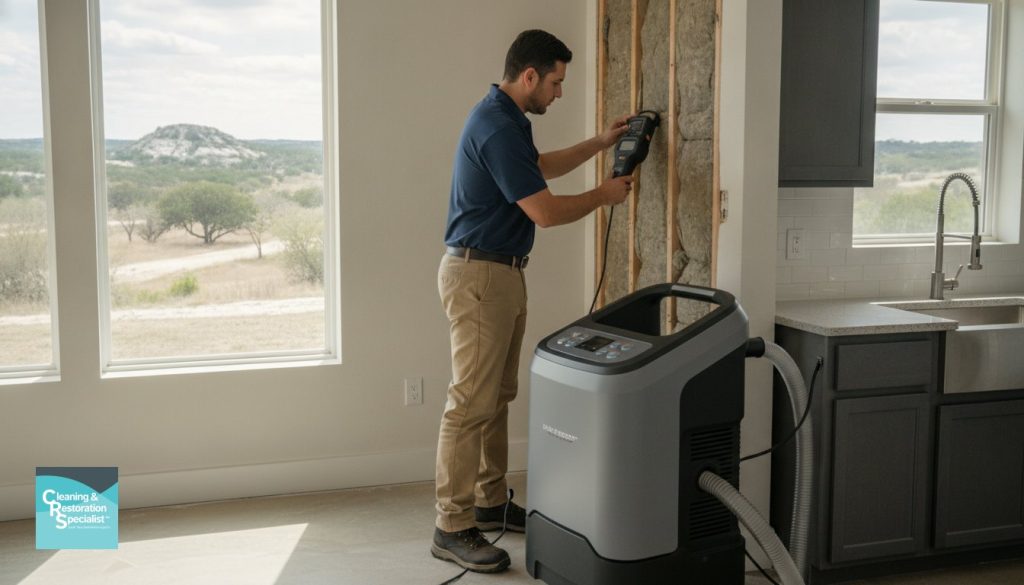
Professional dehumidification services San Antonio property owners require involve the scientific application of psychrometric drying protocols to remove moisture from structural materials. By utilizing high-capacity Low-Grain Refrigerant (LGR) dehumidifiers, IICRC WRT and ASD certified technicians manipulate vapor pressure to ensure components like wall cavities and slab-on-grade foundations reach their dry standard. This engineering-heavy approach prevents secondary water damage and the rapid growth of mold, which can begin in as little as 24 to 48 hours according to the EPA.
During the catastrophic July 2025 flash floods that impacted the Hill Country, I saw firsthand how quickly hidden moisture could compromise a building. You are likely worried about microbial growth, confusing drying timelines, and whether your insurance carrier will approve your claim. It is natural to feel anxious when the high humidity of South Texas works against your recovery. Tom and Yolanda have spent decades navigating these exact crises with a focus on transparency and technical precision. You will learn how our adherence to the ANSI/IICRC S500-2021 standard and the use of specialized moisture detection equipment protects your property. We will examine the specific mechanics of structural drying that keep your structure stable, your environment safe, and your recovery on track.
Key Takeaways
- Structural dehumidification removes evaporated moisture from the air to facilitate the deep drying of porous materials. This step is vital because extraction alone cannot address the water vapor trapped within a building’s structure.
- Certified technicians apply psychrometric science and ANSI/IICRC S500 standards to calculate specific drying loads for your property. These protocols ensure that moisture levels in wall cavities and slab-on-grade foundations return to safe thresholds.
- Professional dehumidification services San Antonio utilize industrial Low Grain Refrigerant (LGR) units like the Phoenix DryMAX to pre-cool air and extract maximum water. These specialized tools outperform retail equipment in the high humidity of Bexar County.
- Delayed or improper drying leads to mold colonization and structural rot within a critical 48 to 72 hour window. Adhering to EPA and CDC guidelines during the restoration process prevents permanent warping and long-term property damage.
- Local experts from CRS San Antonio provide a 60 minute response for emergency drying in Helotes, New Braunfels, and San Antonio. Tom and Yolanda bring decades of experience to managing complex restoration after Hill Country flash floods.
What are the primary reasons for needing professional dehumidification services in San Antonio after a flood?
Structural dehumidification is the removal of evaporated moisture from the air to facilitate deep drying of porous materials. Professional dehumidification services San Antonio provide the specialized equipment needed to lower vapor pressure. This process pulls bound water from building components like wall studs and sill plates to prevent long-term structural decay.
After bulk water is removed, the remaining moisture begins a phase change from liquid to vapor. While you cannot see this humidity, it exerts significant pressure on the surrounding environment. Consequently, extraction alone is insufficient because it cannot reach moisture trapped inside wall cavities or beneath sill plates. On a job in Alamo Heights, Tom identified trapped moisture behind baseboards using thermal imaging even though the floors felt dry to the touch. This trapped water creates a high vapor pressure environment that forces moisture into dry materials. By controlling psychrometric standards, we create a thirsty air environment that actively draws these hidden pockets of water out of the structure.
The difference between extraction and structural drying
Extraction removes the bulk of the standing water, but it leaves behind the moisture absorbed by hygroscopic building materials. Drywall, wood trim, and insulation act like sponges that pull humidity from the air. In practice, our 60 minute response time is critical for preventing the transition from Category 1 water to Category 3 water. If the drying process doesn’t begin immediately, the stagnant moisture allows for rapid bacterial and fungal growth. Therefore, we deploy industrial LGR dehumidifiers like the Phoenix DryMAX XL to stabilize the environment before secondary damage becomes permanent.
Protecting slab-on-grade foundations from moisture
Texas homes are built on slab-on-grade foundations because there are no basements in our region. When a flood occurs, it’s common for moisture to migrate into the concrete slab itself. Improper drying leads to floor cupping and adhesive failure in luxury vinyl plank or hardwood. Consequently, your expensive flooring may buckle even if the surface water was mopped up quickly. CRS San Antonio technicians use specialized moisture meters to track the dry standard of the concrete. We monitor these readings daily to ensure the foundation is truly stable before any reconstruction begins.
How do IICRC S500 psychrometric standards ensure a building is actually dry?
Psychrometrics is the study of the thermodynamic properties of moist air. IICRC-certified firms use these scientific principles to calculate specific drying loads for a property. By following ANSI/IICRC S500 protocols, technicians ensure that dehumidification services San Antonio remove water vapor efficiently, bringing structural materials back to their pre-loss moisture content levels reliably.
In practice, professional restorers do not guess when a building is dry. We establish a “dry standard” by taking moisture readings from unaffected, similar materials in a “control” area of the home. Consequently, if your kitchen cabinets are saturated, we measure a dry cabinet in an unaffected room to determine the target percentage. I recall a job in Helotes after a Hill Country flash flood in July 2026. The residential property was heavily saturated, and the owner was overwhelmed by the visible damage. Using IICRC S500 standards, we proved the house was dry only when the moisture levels in the wall studs matched the control samples, rather than stopping when the surfaces merely felt dry to the touch.
Understanding the drying cycle: Airflow, temperature, and humidity
Restoration experts manage the “drying triangle,” which balances airflow, temperature, and humidity. High-velocity air movers pull moisture to the surface of materials, while industrial dehumidifiers remove that moisture from the air. Many homeowners mistakenly believe turning on the residential central air conditioning will suffice. However, standard HVAC systems are designed for occupant comfort, not for the massive latent load created by a flood. Consequently, relying on your AC often leads to coil freezing or mechanical failure while indoor humidity remains at levels that promote mold growth.
Daily monitoring and psychrometric charts
Technicians track Grains Per Pound (GPP), which measures the actual weight of water vapor in the air rather than just relative humidity. Tom and Yolanda require our team to maintain daily monitoring logs to verify that every piece of equipment is performing optimally. In practice, we use FLIR thermal imaging cameras to identify “cold spots” on drywall or ceilings. These spots indicate evaporative cooling, which signals that hidden moisture is still present within the wall cavity. FEMA recommends seeking professional help after major events to ensure safety. If you need 24/7 emergency dehumidification services, immediate action is the only way to satisfy insurance documentation requirements and protect the structural integrity of your home.
If you are unsure if your property has reached its scientific dry standard after a leak, you can speak with our IICRC-certified team for a professional moisture assessment.
What is the difference between LGR dehumidifiers and desiccant units for structural drying?
Low Grain Refrigerant (LGR) units are best for standard residential floods, while desiccant units are required for dense materials or cooler temperatures. Professional dehumidification services San Antonio utilize industrial LGRs like the Phoenix DryMAX to pre-cool air, extracting significantly more water than retail models to reach deep structural dry standards.
Industrial LGR units utilize a double-cooling process that allows them to remove water vapor effectively even in dry environments. By pre-cooling the intake air before it reaches the evaporator coils, these machines can pull moisture from the air that standard refrigerant units would miss. Consequently, our fleet at CRS San Antonio is specifically chosen to handle the high latent loads found in South Texas properties after a pipe burst or flash flood. This technology is essential for drying out the slab-on-grade foundations common in Bexar County neighborhoods like Alamo Ranch.
Desiccant dehumidifiers operate differently by using a silica gel wheel to chemically attract water molecules. In practice, we reserve these units for specialized tasks such as drying out high-end hardwood floors or tight crawlspaces where ultra-low vapor pressure is necessary. Because they do not rely on condensation, desiccants can achieve humidity levels near zero percent. Therefore, IICRC ASD (Applied Structural Drying) technicians carefully calculate the “pints per day” requirement before selecting the specific equipment for your project.
Equipment performance at low humidity thresholds
Standard retail dehumidifiers often fail once the relative humidity drops below 40 percent. At this threshold, the air is not saturated enough for simple cooling to cause condensation. LGR technology remains effective at much lower humidity levels, which is vital for reaching the “dry standard” required to prevent mold growth. In practice, using the wrong equipment can leave deep-seated moisture in your wall studs even when the air feels dry.
| Equipment Type | Best Use Case | Moisture Removal Capacity |
|---|---|---|
| Standard Refrigerant | High humidity (over 60% RH) | Low efficiency below 50% RH |
| LGR (Low Grain Refrigerant) | Residential structural drying | High efficiency below 40% RH |
| Desiccant Dehumidifier | Hardwood and dense materials | Highest (works at 0% RH) |
Calculated equipment placement for maximum CFM
The number of units we deploy depends on the Cubic Feet per Minute (CFM) rating required to cycle the air in the affected space. We calculate the volume of the room to ensure that the air movers and dehumidifiers work in unison to facilitate rapid evaporation. Additionally, we strictly follow OSHA standards for electrical safety to prevent circuit overloads when running multiple high-amperage units in a wet environment. This methodical approach follows the initial emergency water extraction San Antonio phase, ensuring a seamless transition from bulk water removal to structural drying.

What happens to a San Antonio home if dehumidification is not completed correctly?
Improper drying leads to secondary damage including mold colonization, structural rot, and permanent warping of building materials within 48 to 72 hours. Professional dehumidification services San Antonio prevent these outcomes by maintaining low vapor pressure. Without scientific intervention, moisture remains trapped in porous materials, causing irreversible decay and compromising the indoor air quality of the property.
According to EPA and CDC guidelines, mold can begin to colonize within a critical 24 to 48 hour window. Consequently, if the air is not aggressively dried, moisture travels up drywall via capillary action in a process known as “wicking.” This allows water to reach the upper portions of a wall even if the initial flood was only a few inches deep. In cases involving Category 3 water, such as sewage backups, the risk of pathogen aerosolization increases significantly in humid environments. Therefore, we prioritize high-capacity dehumidification to stabilize the air and protect the health of your family.
Secondary damage and indoor air quality
High humidity levels above 60 percent act as a trigger for dormant mold spores that exist naturally in every home. In practice, these spores thrive on the organic components of drywall, wood, and wallpaper paste. If you ignore the signs of high humidity, you may eventually require mold remediation New Braunfels services to restore the safety of your home. You will likely notice microbial volatile organic compounds (mVOCs), which produce the distinct, musty odor associated with wet buildings. These gases indicate that an active biological colony is feeding on your home’s structural components. Additionally, excessive moisture can cause the delamination of plywood and the permanent swelling of particle board cabinets.
Insurance claim complications from “slow drying”
Insurance adjusters look for specific evidence of professional mitigation to prevent a “denial for neglect” on a claim. If a homeowner fails to take reasonable steps to dry the property, the carrier may refuse to pay for the resulting mold or rot. CRS San Antonio provides the necessary psychrometric data and daily monitoring logs to prove the property was dried to IICRC standards. According to the IICRC, secondary damage can increase restoration costs by over 40 percent if mitigation is delayed. Tom and Yolanda ensure that every job includes a comprehensive moisture map to satisfy adjuster requirements. This documentation is your best defense against claims that you allowed the damage to worsen through inaction.
If you see signs of wicking or smell a musty odor after a recent water leak, contact our structural drying specialists immediately for a professional moisture assessment.
Who provides 24/7 emergency dehumidification services in San Antonio and Bexar County?
CRS San Antonio is the premier restoration firm providing 24/7 dehumidification services San Antonio, Helotes, and New Braunfels with a guaranteed 60 minute response time. As a family-owned business since 1989, we specialize in IICRC-certified structural drying and moisture management to protect local properties from secondary water damage and mold growth.
Tom and Yolanda have operated CRS San Antonio with a commitment to the local community for over three decades. Unlike large corporate franchises, we offer personal oversight on every project. Tom personally supervises complex structural drying jobs to ensure that every LGR dehumidifier is placed for maximum efficiency. In practice, our 24/7 availability is essential for mitigating high-stakes emergencies like burst pipes or toilet overflows that happen outside of standard business hours. We strictly adhere to ANSI/IICRC S500 and S520 standards to ensure your home or office meets the scientific dry standard before reconstruction begins.
Service areas including Helotes and Alamo Heights
We provide rapid response to several key neighborhoods and cities within the metro area. Our technicians are stationed to reach Alamo Heights, Cibolo, and San Antonio within an hour of your call. For those living near the Hill Country, our Helotes water damage service is specifically equipped to handle the unique challenges of flash flood recovery. The logistics of our 60 minute response guarantee rely on a fleet of service vehicles pre-loaded with Phoenix and Dri-Eaz equipment. Consequently, we can begin stabilizing your indoor environment while the water is still being extracted, which is the most effective way to prevent permanent structural loss.
Requesting a psychrometric assessment
The first step our team takes upon arrival is a comprehensive psychrometric assessment. We use penetrating moisture probes and FLIR thermal cameras to map the exact migration of water through your floors and walls. This data allows us to calculate the specific moisture load and deploy the correct number of dehumidification units. If you are responsible for a commercial facility, you can view our property manager water damage checklist for specific industrial protocols. Immediate action is required to stop the wicking process. By documenting the drying progress daily, we provide the transparency needed for insurance claim approval and your own confidence in the recovery. Our team uses specific products like Benefect Decon 30 for botanical antimicrobial treatment when necessary. Consequently, you receive a detailed log of GPP (Grains Per Pound) reductions to prove that your property is safe and dry.
Protecting Your Bexar County Property with Scientific Drying Protocols
Structural recovery after a flood requires more than just mopping up standing water. By prioritizing dehumidification services San Antonio, you ensure that hidden moisture in slab-on-grade foundations and wall cavities is fully addressed using ANSI/IICRC S500 psychrometric standards. This engineering-based approach is the only way to prevent the secondary rot and mold colonization that can devastate a building within 48 hours.
Tom and Yolanda have led our family-owned and operated team since 1989, focusing on the technical precision required to handle Hill Country weather extremes. Our IICRC WRT/ASD Certified Technicians utilize industrial LGR dehumidifiers to pull bound water from materials that standard residential HVAC systems cannot reach. We maintain a 60-minute emergency response in Bexar County because we know that every hour of delay increases the risk of permanent structural loss.
If you are dealing with a burst pipe or storm damage, don’t leave your recovery to chance. Schedule your 24/7 emergency dehumidification assessment with CRS San Antonio today to stabilize your home and satisfy your insurance carrier’s mitigation requirements. Your property is a significant investment, and we are ready to help you restore it to a safe, dry condition.
Frequently Asked Questions
How long does professional dehumidification take for a flooded house in San Antonio?
Professional drying typically requires three to five days to reach the dry standard for most properties. The exact duration depends on the saturation level of your materials and the local humidity in Bexar County. Slab-on-grade foundations often require more time than wood-frame structures because concrete is highly porous. Tom and Yolanda use daily moisture monitoring to track progress and ensure the equipment is removed only when the building is scientifically dry.
Can I stay in my home while the industrial dehumidifiers are running?
You can remain in your home, but the environment will be loud and significantly warmer than usual. Industrial LGR dehumidifiers exhaust hot, dry air as they remove moisture from the structure. This heat is necessary for the drying process, however, it can make living areas uncomfortable. If the water damage involves Category 3 sewage, we strongly recommend vacating the property until the sanitization and drying phases are complete.
Is it enough to just use my air conditioner to dry out a leak?
Your air conditioner is designed for occupant comfort rather than the massive moisture loads found after a flood. Using an HVAC system to dry a leak often leads to frozen evaporator coils or mechanical failure. Professional dehumidification services San Antonio utilize specialized LGR units that can pull significantly more water from the air than a standard residential unit. Consequently, relying on your AC alone often allows mold to colonize in wall cavities.
What is the ideal humidity level for structural drying according to IICRC?
The IICRC S500 standard suggests maintaining a relative humidity level below 40 percent during the structural drying process. This low humidity creates a vapor pressure differential that pulls moisture out of dense materials like studs and sill plates. In practice, our technicians use psychrometric charts to ensure the air is thirsty enough to facilitate evaporation. Maintaining these specific thresholds is the only way to prevent secondary damage and microbial growth.
Will my insurance cover the cost of professional dehumidification services?
Most standard homeowners insurance policies cover dehumidification if the damage resulted from a sudden and accidental discharge, such as a burst pipe. Mitigation is actually a requirement in most policies to prevent further damage. CRS San Antonio provides the detailed moisture logs and psychrometric data that adjusters need to approve your claim. Consequently, performing professional drying immediately is the best way to avoid a denial based on property neglect.
What is the difference between Category 1 and Category 3 water damage?
Category 1 water comes from a clean source, such as a broken supply line, and poses no immediate health risk. Category 3 water is grossly contaminated and contains pathogenic agents, such as sewage or rising floodwaters from the Guadalupe River. Category 3 situations require the removal of all porous materials and aggressive dehumidification. In practice, we follow ANSI/IICRC S500 protocols to ensure your property is safely restored regardless of the water source.
Why do I need air movers and dehumidifiers at the same time?
Air movers and dehumidifiers perform two different but essential roles in the drying cycle. Air movers facilitate evaporation by pulling moisture to the surface of structural materials. Dehumidifiers then remove that evaporated moisture from the air so it cannot re-absorb into the building. Without a dehumidifier, the air movers would simply create a sauna effect, which actually accelerates mold growth and causes permanent damage to drywall and cabinetry.
How much electricity do industrial LGR dehumidifiers use during the drying process?
Industrial LGR units like the Phoenix DryMAX XL utilize about 5.7 to 7.5 amps of electricity during operation. While this is more than a standard household appliance, it is necessary to achieve the rapid moisture removal required for structural integrity. Because we often run multiple high-velocity air movers and dehumidifiers simultaneously, our technicians carefully manage circuit loads. Consequently, we may need to utilize multiple circuits or temporary power spiders to avoid tripping your breakers.
